Rosacea Awareness Month — What Your Skin Is Actually Telling You
April is Rosacea Awareness Month, and this year it feels particularly relevant. We've been seeing it more and more in clinic — clients coming in frustrated, confused, and often having made things significantly worse before finding their way to us.
If your skin flushes easily, stays persistently red, or keeps breaking out in ways that don't quite behave like normal acne, this is worth reading.
![[Skin Concerns] 30yo this last year my cheeks are always red with little bumps is this rosacea_ Not sure what to do!.jpeg](https://images.squarespace-cdn.com/content/v1/69d62a200b3bd84c3f0621ea/1776057670973-NUPXI10B1Y4D463IN7RI/%5BSkin+Concerns%5D+30yo+this+last+year+my+cheeks+are+always+red+with+little+bumps+is+this+rosacea_+Not+sure+what+to+do%21.jpeg)
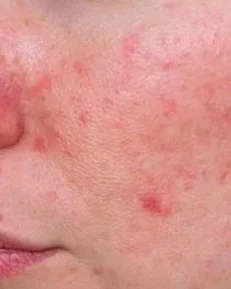
Rosacea is one of the most misunderstood skin conditions we treat
It's chronic, it's complex, and it looks different on every face. Yet it's consistently underdiagnosed, mistreated, and misidentified — most often as acne, sensitivity, or "just redness." That misidentification matters enormously, because the wrong treatment approach doesn't just fail to help rosacea. It actively makes it worse.
What rosacea actually is
Rosacea is a chronic inflammatory skin condition driven by vascular hypersensitivity and immune dysregulation within the skin. It isn't caused by poor hygiene, the wrong products, or a damaged routine. It's a condition with a genuine biological basis — and one that requires a genuinely different approach to manage.
It presents across a spectrum, but the two subtypes we see most consistently in clinic are:
Erythematotelangiectatic rosacea — characterised by persistent facial redness, frequent flushing, visible broken capillaries, and skin that reacts strongly to heat, temperature change, products, and lifestyle triggers. The skin often feels sensitive, tight, and unpredictable.
Papulopustular rosacea — the subtype most commonly mistaken for acne. It presents with redness alongside pustules and papules, typically across the cheeks, nose, and chin. Unlike acne, it isn't driven by excess oil or blocked pores. Treating it with acne protocols — strong actives, exfoliants, drying ingredients — almost always intensifies inflammation rather than resolving it.
The mistake we see most often
Clients arriving at CSA with rosacea have frequently spent months — sometimes years — treating it like acne. Salicylic acid, azeleic acid, benzoyl peroxide, aggressive exfoliation, multiple actives layered together. The logic makes sense on the surface. The skin is breaking out, so treat the breakouts.
But rosacea pustules aren't acne. They're an inflammatory response within already sensitised, vascular-reactive skin. Stripping and exfoliating that skin doesn't clear it — it dismantles the barrier, amplifies inflammation, and accelerates the cycle.
By the time many clients reach us, the original rosacea is compounded by significant barrier damage. We're managing two things at once.
What's actually triggering your flares
This is where rosacea gets personal. The condition itself is consistent in its biology, but the triggers vary significantly from person to person. What we see most in clinic right now — particularly coming out of summer — are flares driven by lifestyle and internal factors that clients haven't connected to their skin at all.
Heat and UV exposure are among the most reliable rosacea triggers, which is why post-summer presentations are so common this time of year. But beyond that, we frequently see flares linked to alcohol consumption, particularly wine and spirits, spicy food, chronic stress and elevated cortisol, hormonal fluctuations, gut health imbalances, and disrupted sleep. None of these show up on a skin analysis. But all of them influence vascular reactivity and systemic inflammation — the two core drivers of rosacea.
This is also why the homecare routine alone is rarely enough. Rosacea managed only at the surface will keep cycling. The internal environment needs attention too.
How we approach rosacea at Curated Skin Aesthetics
There is no single treatment that resolves rosacea. What works is a considered, layered approach that calms the skin, rebuilds the barrier, and addresses contributing internal factors alongside clinical treatment.
Our approach typically begins with barrier repair. Before anything corrective can happen, the skin needs to be stabilised — reducing reactivity, restoring hydration, and strengthening the lipid matrix that protects against environmental triggers. This phase is non-negotiable. Corrective treatment on a compromised barrier will always underdeliver.
From there, we build a treatment plan that may include:
LED light therapy — one of the most valuable tools we have for rosacea-prone skin. It calms vascular inflammation, supports barrier repair, and reduces redness without any thermal stimulation that could trigger further flushing.
Environ DF infusion treatments — using iontophoresis and sonophoresis to deliver deeply calming, hydrating, and barrier-supportive ingredients into the skin without aggression or heat.
Our Custom Prescription Skincare Range — formulated specifically for sensitised, reactive skin. Rather than generic over-the-counter products that can unpredictably trigger rosacea, our prescription range allows us to select and compound ingredients precisely matched to what each skin needs, in concentrations that support rather than provoke.
Naturopathic support with Kayla — because rosacea is as much an internal condition as a skin one. Kayla works with clients to identify gut health contributors, hormonal influences, and lifestyle triggers, building an internal support plan that works alongside clinical treatment.
What managing rosacea actually looks like
It's important to be honest about this. Rosacea is a chronic condition — it cannot be permanently cured. But it can be very well managed. With the right approach, most clients experience significantly reduced flushing, fewer flares, stronger barrier function, and skin that feels more stable and predictable across the month.
The goal isn't perfection. It's understanding your skin well enough to support it consistently — knowing your triggers, having a homecare routine that calms rather than provokes, and having a clinical team that adjusts your plan as your skin evolves.
That's what long-term rosacea management looks like in practice.
If this sounds like your skin
Rosacea is often suffered quietly — dismissed as sensitivity, masked with makeup, or treated with products that keep the cycle going. If your skin flushes easily, reacts unpredictably, or breaks out in ways that don't respond to conventional acne treatment, it's worth having a proper conversation.
A thorough consultation is where we start — understanding your skin's history, your triggers, your current routine, and what's actually driving what you're seeing. From there, we build a plan that addresses your skin specifically.
Because managing rosacea well isn't about finding the right product. It's about understanding the whole picture.
Ready to get clarity on your skin? Book a consultation with our team at Curated Skin Aesthetics and we'll start from the beginning — with yours.
Because great skin isn't luck. It's curated.