How to Read Skincare Marketing Claims (Without Falling For Them)
Every skincare product is trying to tell you something before you've even opened it. The label, the packaging, the phrase printed across the front — "clean," "clinically proven," "dermatologist-loved" — all of it is designed to answer one question before you've asked it: is this worth my money?
The problem is that most of those words aren't regulated, aren't standardised, and aren't required to mean anything specific. That doesn't make them lies. It makes them marketing. And marketing and evidence are not the same thing. Here's what's actually behind five of the most common claims in skincare, and how to evaluate a product on its merits instead of its messaging.
"Natural" vs "synthetic"
One of the most persistent myths in skincare is that natural ingredients are inherently safer or better, and synthetic ones are inherently harsher. Your skin doesn't know — or care — where a molecule came from. It responds to the molecule itself: its structure, its concentration, its stability. Not its origin story.
In fact, laboratory-produced ingredients are frequently the more reliable choice, precisely because they're manufactured to a consistent standard. Plant-derived ingredients can vary batch to batch depending on soil quality, weather, harvest timing, and extraction method, which means the concentration of the active compound can shift from bottle to bottle even under the same label. A synthetic version of that same compound is built to be pure, stable, and dosed the same way every time.
Neither category is superior by default. The only question worth asking is whether the specific ingredient, in that specific formulation, is safe, stable, and supported by evidence — regardless of which column it falls into.
"Clinically proven"
This phrase carries enormous weight with almost no regulation behind it. Technically, a brand can run a study on a small handful of participants over a short period and still describe the product as "clinically proven" or "clinically tested." That single study might be real. It might also tell you very little.
Evidence-informed skincare isn't built from one study — it's built from a body of research. The strongest claims are backed by multiple, independent, peer-reviewed studies that have been replicated and consistently show the same result. A single in-house trial funded by the brand selling the product is a much lower bar than that, even though the phrase on the label sounds identical either way.
When you see "clinically proven," the useful next question isn't whether to trust it — it's what the claim is actually resting on. How many participants. How long. Independently reviewed, or brand-funded. A confident marketing phrase can't answer any of that for you.
Hero ingredients
Vitamin C. Retinol. Niacinamide. Peptides. Marketing loves to put one ingredient on the front of the bottle and let it carry the entire story. But an ingredient being present on the label doesn't tell you whether the product actually performs.
Efficacy depends on the whole formulation, not one headline ingredient. The specific form of that ingredient matters — there are multiple forms of vitamin C alone, with very different stability and penetration profiles. Concentration matters. So does pH, the packaging it's stored in (some actives degrade rapidly when exposed to light or air), and what else the ingredient is formulated alongside, since some combinations enhance an active and others cancel it out.
A single hero ingredient doesn't guarantee an effective product, in the same way one good instrument doesn't guarantee a good orchestra. It's the formulation as a whole — concentration, stability, delivery, and supporting ingredients — that determines whether an active actually does anything once it's on your skin.
Buzzwords without definitions
"Medical grade." "Clean." "High strength." "Science-backed." These phrases show up on almost every second product, and they're designed to make something sound more credible before you've read a single ingredient.
The issue is that most of these terms have no standard legal definition in cosmetics. "Clean" doesn't have an agreed list of what's excluded. "Medical grade" isn't a regulated category the way a prescription medication is. That means a brand can use language like this without it proving the product is any more effective — or any more "medical" — than the one next to it on the shelf.
None of this means the product is bad. It means the words on the front of the bottle aren't the evidence. The evidence — if it exists — is in published research, ingredient concentrations, and formulation quality, not in the adjective chosen for the label.
Luxury packaging and the halo effect
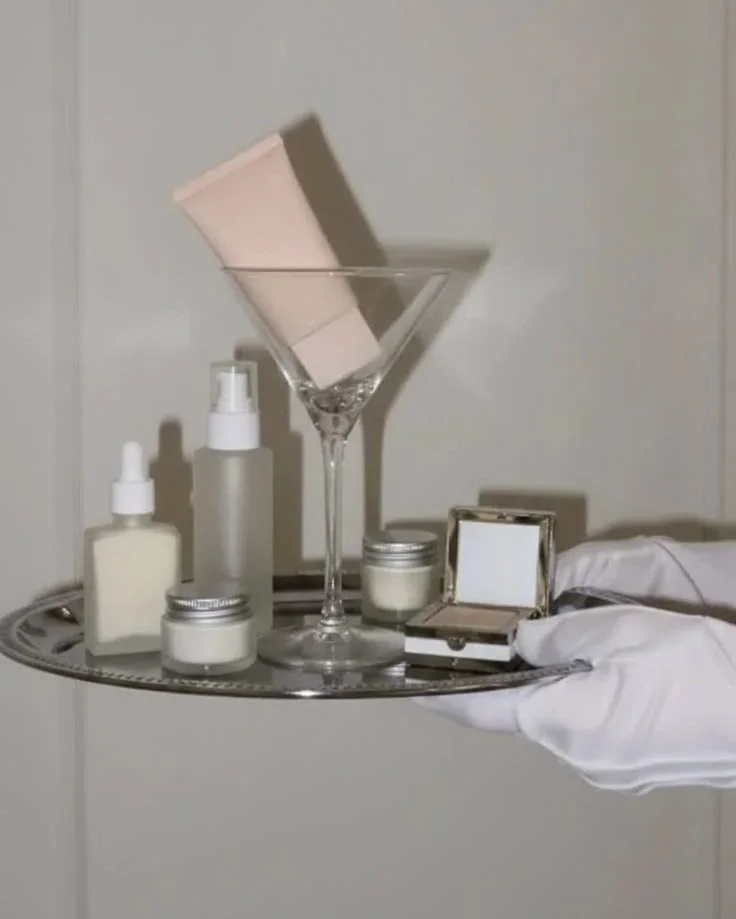
Heavy glass, minimalist branding, a satisfying pump action, a box that feels expensive in your hands — all of this creates an impression of quality before the product has done anything at all. That impression has a name: the halo effect, a well-documented psychological bias where one strong positive impression (in this case, the packaging) colours how we judge everything else about the product, including how well we assume it will work.
It's a large part of why premium skincare often feels more effective, even when the underlying formulation is similar to a far less expensive alternative. Beautiful packaging isn't dishonest, and it isn't a bad thing — presentation is a legitimate part of a brand's experience. But it isn't information about the formula inside. It can't tell you the concentration of the active ingredient, how it was tested, or how it will interact with your specific skin.
What to check instead of what to trust
Language on a label is written to persuade. Evidence is written to inform. They can overlap, but they aren't the same thing, and a package covered in the right buzzwords can still be a genuinely well-formulated, well-evidenced product — the label just isn't how you'd know that.
The more useful habit is to look past the front of the bottle: the full ingredient list, the concentration of actives where it's disclosed, the form of the ingredient used, and whether there's independent evidence behind the specific claim being made — not just the category it belongs to. It's a slower way to shop. It's also the only way that actually tells you something.
This is exactly why we don't build routines from what's trending or what a label promises. Every product recommendation at Curated Skin Aesthetics is assessed against your skin specifically — what it needs, what it can tolerate, and what the evidence actually supports. Not what's written on the front of the bottle.
If you'd like a routine built on what your skin actually needs rather than what's currently trending, book a Skin Consultation and we'll start with a proper assessment.